
Root Cause Found in Minutes.
Not Days of Investigation.
When something goes wrong, your team shouldn't spend days tracing the cause through disconnected documents. Brains connects your HazOps, P&IDs, and historian data through the Contextual Graph — tracing the root cause from the operational anomaly back to the engineering origin automatically.
Book a DemoRisks Identified, Events Connected, Root Cause Found.
Traditional root cause analysis starts after the failure and works backwards — pulling P&IDs from filing cabinets, cross-referencing HazOps, reviewing historian trends, interviewing operators. Brains has already mapped the relationships. The path from anomaly to root cause is pre-built in the Graph.
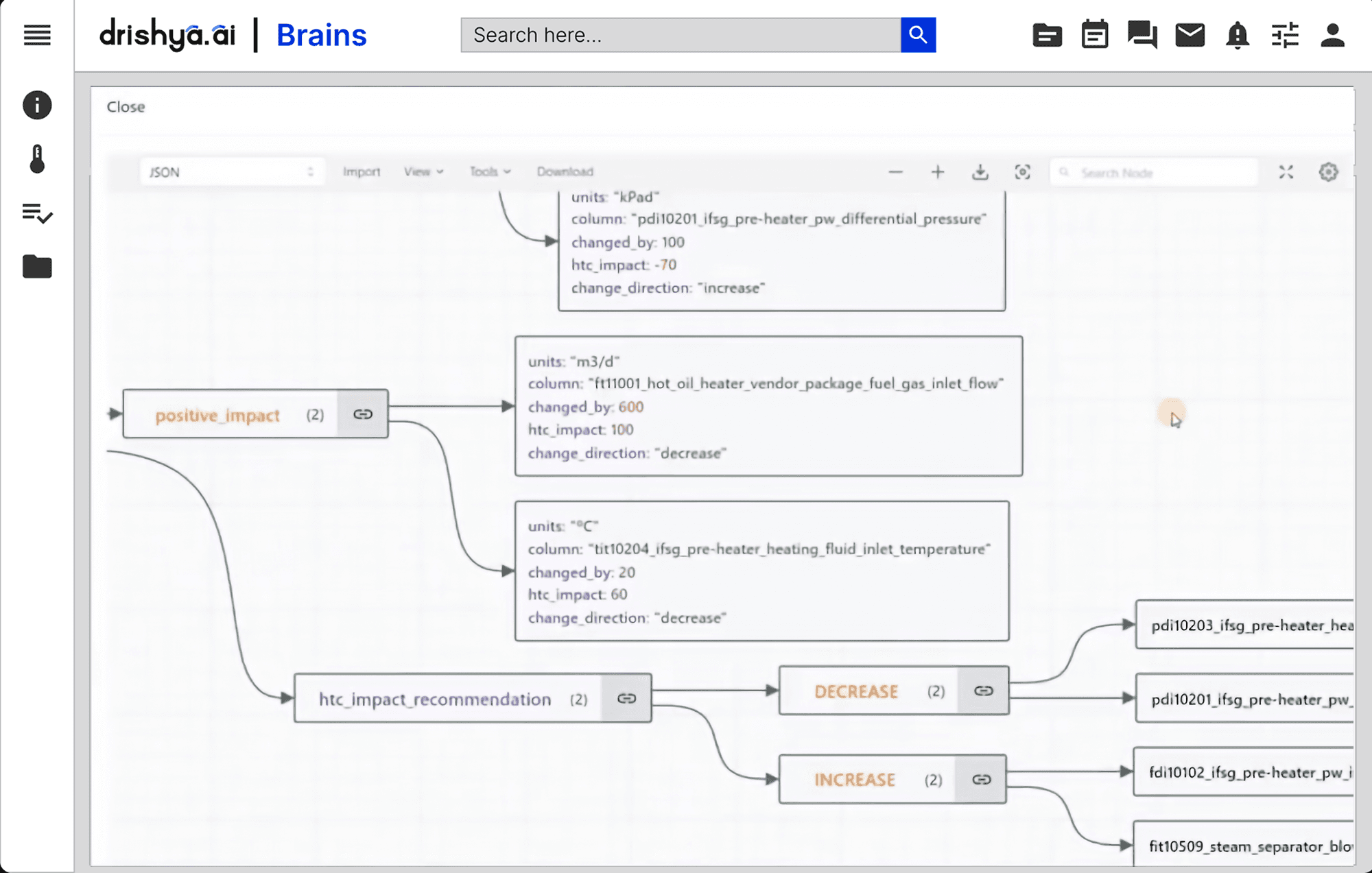

From Anomaly to Engineering Origin.

HazOp-Integrated Root Cause Mapping
Your HazOp reports identify what can go wrong, what the causes are, and what safeguards exist. Brains digitizes these reports into the Hazard Layer of the Contextual Graph — so when an anomaly occurs, the HazOp analysis is already connected to the live operational data.

Operational-to-Engineering Traceability
A sensor spike isn't just a number. Brains traces it through the Graph — from the sensor reading to the equipment it monitors, to the P&ID that defines the process, to the HazOp that assessed the risk, to the safety barriers designed to prevent the failure. One trace. Every layer.

Dynamic Pattern Recognition
Brains identifies patterns in your operational data that correlate with root causes documented in your HazOps. When the pattern reappears, the probable root cause is surfaced immediately — not discovered through a week-long investigation after the fact.

Multi-Failure Correlation
When multiple anomalies occur across different equipment, Brains traces them through the Graph to determine whether they share a common root cause. Your investigation team sees one origin, not five separate incidents — collapsing investigation time from days to minutes.

Safety Barrier Validation
When a root cause is identified, Brains automatically checks which safety barriers should have activated — SIL-rated instruments, IPLs, shutdown systems — and verifies their status. Were the designed protections in place? Did they function? The Graph knows.

RCA Reports With Engineering Citations
Every root cause Brains identifies comes with full engineering citations — the P&ID reference, the HazOp node, the historian trend, the safety barrier status. Your investigation report writes itself from the Graph. No manual document assembly required.
HazOp-Integrated Root Cause Mapping
Your HazOp reports identify what can go wrong, what the causes are, and what safeguards exist. Brains digitizes these reports into the Hazard Layer of the Contextual Graph — so when an anomaly occurs, the HazOp analysis is already connected to the live operational data.
Operational-to-Engineering Traceability
A sensor spike isn't just a number. Brains traces it through the Graph — from the sensor reading to the equipment it monitors, to the P&ID that defines the process, to the HazOp that assessed the risk, to the safety barriers designed to prevent the failure. One trace. Every layer.
Dynamic Pattern Recognition
Brains identifies patterns in your operational data that correlate with root causes documented in your HazOps. When the pattern reappears, the probable root cause is surfaced immediately — not discovered through a week-long investigation after the fact.
Multi-Failure Correlation
When multiple anomalies occur across different equipment, Brains traces them through the Graph to determine whether they share a common root cause. Your investigation team sees one origin, not five separate incidents — collapsing investigation time from days to minutes.
Safety Barrier Validation
When a root cause is identified, Brains automatically checks which safety barriers should have activated — SIL-rated instruments, IPLs, shutdown systems — and verifies their status. Were the designed protections in place? Did they function? The Graph knows.
RCA Reports With Engineering Citations
Every root cause Brains identifies comes with full engineering citations — the P&ID reference, the HazOp node, the historian trend, the safety barrier status. Your investigation report writes itself from the Graph. No manual document assembly required.
Your investigation team spends days after a failure pulling P&IDs, reviewing HazOps, and cross-referencing historian data. The relationships between those documents already exist in the Graph. The root cause is a query, not an investigation.
Frequently Asked Questions
Common questions about HazOp-driven root cause analysis.
Brains digitizes your HazOp reports into the Hazard Layer of the Contextual Graph — extracting nodes, deviations, causes, consequences, and safeguards. When an operational anomaly occurs, Brains checks it against the HazOp analysis — determining whether the current event matches a previously identified risk scenario, what the documented causes are, and which safety barriers should be active.
No. Brains accelerates the investigation phase — the time between "something happened" and "we know why." Your formal RCA process, incident documentation, and corrective action tracking remain unchanged. Brains provides the engineering evidence and root cause hypothesis in minutes instead of days, so your investigation team starts from a probable cause, not from a blank page.
Artisan can digitize your HazOp reports as part of building the Contextual Graph. Once digitized, the HazOp data is connected to your P&IDs, datasheets, and operational data — enabling the root cause traceability that Brains provides. The same document digitization capability that handles P&IDs and ISOs handles HazOps.
When multiple anomalies fire across different equipment or systems, Brains traces each one through the Contextual Graph to find whether they share a common upstream cause. A pressure anomaly on one vessel and a temperature anomaly on a downstream exchanger might both trace back to a control valve malfunction identified in the same P&ID process line. Brains makes that connection through the Graph.
Yes — through pattern recognition. Brains identifies operational patterns that historically preceded failures documented in your HazOps and incident reports. When the same pattern reappears, Brains flags the probable root cause and the associated risk scenario before the failure materializes. This shifts RCA from reactive investigation to proactive prevention.
Ready to Find Root Causes in Minutes Instead of Days?
Connect your HazOps, P&IDs, and historian data. See root causes traced through the Contextual Graph — from operational anomaly to engineering origin, with full citations.
- Trace root causes from sensor readings to engineering design in minutes.
- Connect HazOp risk scenarios to live operational data automatically.
- Correlate multiple failures to a single root cause through the Graph.
- Validate safety barrier status against the designed protection layers.
- Generate investigation reports with full engineering citations.